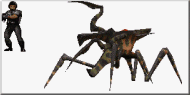
 BASIC INFO: IQ 30. Ground speed exceeds 64 km/hr. Demonstrates a low reactive intelligence with possible telepathic guidance. Rapid reaction to potential threats with tenacious follow-through. Extremely aggressive, dangerous and agile.
ATTACK PATTERNS: Attacks with cutting and chewing mandibles, forward legs function as attack claws. Can be found in scout or sentry roles but they usually attack in swarm formations.
COMMENTS: Ultimate predator, attacks without remorse or fear. Has enough intelligence to avoid slower projectiles.
Special characteristic: Never escapes from combat.
Week point: Torso/leg part connection (nerve center).
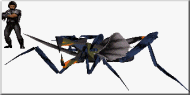 BASIC INFO: IQ 30. Ground speed exceeds 64 km/h. Airspeed up to 341 km/hr. Can also make single jumps up to 50 meters with a low glide ratio (1:3). Very aggressive and deadly. His razor sharp jaws and claws have a high piercing damage factor.
ATTACK PATTERNS: Armed with cutting and slashing wings, attack claws, and a stinger. Attacks in simple formations, scout or reconnaissance missions. Similar to Warrior bug in behavior patterns, but works in small groups or as a single unit.
COMMENTS: Rotary cannon is the best weapon for eliminating this threat. All MI troopers need to know the importance of good surveillance.
SPECIAL CHARACTERISTIC: Hoppers are dangerous even when they are dead. Due to his high speed, inertia will allow Hopper's lifeless body to cover a lot of ground before actually stopping - unless he hit's into an obstacle - such as Troopers. MI advised to strafe out of his trajectory right away. 300 kilograms worth of bug's skeleton traveling at the speed of an aircraft can kill in an instance.
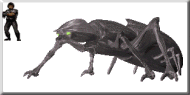 BASIC INFO: IQ: 35. Cross country speed: 35 km/hr. Weight: 3.5 metric tons. Tankers are as aggressive as warriors or hoppers and over 7 times their size and weight. Though less agile in appearance, they are capable of fast movement in combat situations and should never be viewed as slow or clumsy. Bio-corrosive reservoir carries approximately one metric ton of bio-corrosive liquid capable of dissolving MI body armor. Extremely corrosive against exposed flesh.
ATTACK PATTERNS: Armed with cutting and chewing mandibles and bio-corrosive spray with an effective range of approximately 50 meters. Found as single insect, with support of warrior and hopper bugs.Often find in underground tunnels, uses surprise attacks.
COMMENTS: Very aggressive. Should be avoided whenever possible.
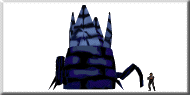 BASIC INFO: IQ: 18. Weight: 7 metric tons. Speed: Less than 2 km/hr. Non-aggressive. Fires burst of plasma ballistically or into high planetary orbit, either to attack the enemy or to accelerate and propel asteroids towards designated targets. It has been also proven that Arachnid society uses plasma bursts to fire their spore into the space and en route to inhabitable planets. Recent studies suggested that they can detect large objects in planet orbit.
ATTACK PATTERNS: High-energy plasma used against spacecraft, for breeding and asteroid launching. ALWAYS protected. Attack on a Plasma battery will result in immediate attack by swarms of Warrior bugs.
COMMENTS: Solifugae bugs are of large tactic importance. They aren't aggressive, and have no way of defending themselves, but they are always protected with swarms of Warriors. It is recommended to avoid plasma batteries, unless otherwise instructed.
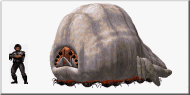 BASIC INFO: IQ: ?(variable). Weight: 2 metric tons. Speed: N/A.
Can be aggressive when confronted, is armed with a piercing claw. Main purpose of the claw is brain matter extraction and assimilation. Brain bug has very high IQ and controls the colony and other units using link-back psycho-kinesis. Recent studies indicated they are capable of reason, and combine extremely effective strategies based on the past experience and knowledge gained with brain matter assimilation. Their level of intelligence increases, and can probably reach or even exceed that of an intelligent human over time.
ATTACK PATTERNS: None. Brain bug is, however, heavily protected by hordes of warrior bugs in almost maniacal manner. Due to it's size, Brain Bug cannot move on it's own and requires Chariot Bugs (drones, non-aggressive) to carry him. Indications are that Brain Bug can even visit the "front lines" and monitor the field event, but this remains to be proven in praxis.
COMMENTS: One of the speculations is that only old, huge colonies develop a Brain Bug with sentient behavior. Existence of "lower class" egg-producing Queens, (similar in the sense of telepathic guidance capability in a reflex-based manner, but with no powers of reason), is not yet proven to be 100% correct. One Brain bug can probably guide attacks and defense strategy of several near-by colonies (although telekinesis is not bound by distance). The data is still rather scarce, but previous experience of the MI encounters with old colonies backs this theory up somewhat. Destruction of the Brain Bug usually hinders Arachnid operational capability and tactics, however there is no "chaos" that should occur if the Brain Bug was the only source of control.
Despite the constant studies and experiments, Brain Bug still remains a mystery. Unfortunately, to capture an alive Brain bug is an almost impossible task (high casualty and cost). Most of the older colonies have to be destroyed together with the Cerberus Rex.
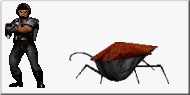 BASIC INFO: IQ: 12. Weight: 220 kilos. Speed: 32 km/hr. Non-aggressive. The main function of Chariot bugs is to carry Queen and Brain Bugs since they are too heavy and large to move on their own. Their presence usually suggests a Brain Bug is in vicinity.
ATTACK PATTERNS: They usually do not respond and ignore all intruders. However, when attacked, Schizopeltida may try to squirt his built-in defense, corrosive acid, in a manner that is closer to a reflex than to agression.
COMMENTS: When killed, Chariot bug releases the contents of his acid reservoir. It is recommended to terminate these from a fair distance.